
Assignment background
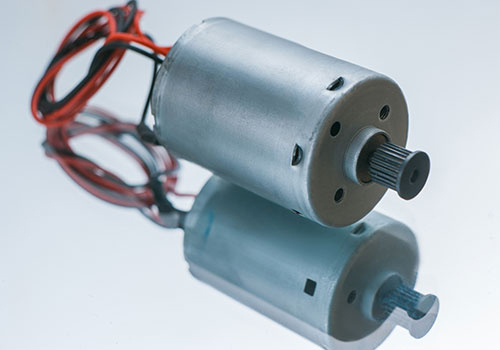
Electric motors are packed with delicate electronic components such as circuit boards, wiring, and sensors, and require reliable protection from moisture, vibration, and temperature fluctuations. For this reason, sealing (potting) using two-part epoxy or urethane is widely used.
However, conventional coating equipment had issues with the stability of the mixing ratio of the base resin and hardener, resulting in the following problems:
- Poor curing due to slight deviation in the mixing ratio
The flow control of the base resin and hardener was unstable, and even a slight deviation in the mixture ratio from the set value could result in poor curing or incomplete curing. This could leave parts of the sealing layer soft or, conversely, make the layer brittle, significantly impairing the insulation and durability of electronic components. - Poor adhesion and voids
Inconsistent material properties due to poor mixing result in reduced adhesion to the board and components, leaving tiny gaps that can cause cracks and peeling due to vibration, negatively impacting the long-term reliability of the motor. - Increased defect rate and inspection burden
Because poor curing is difficult to detect visually, post-process inspection work increases, which leads to higher defect rates and increased costs during mass production, creating a bottleneck in productivity.
Benefits
- Accurate mixing ratio control stabilizes curing quality
The introduction of a two-component volumetric high-precision microdispenser allows for the constant transfer and simultaneous supply of the base resin and hardener with an accuracy of within ±1%. Because the flow rate is automatically controlled while mixing, the mixing ratio is always stable, eliminating the previous issue of poor curing. This has reduced the risk of uncured or poor adhesion to almost zero, dramatically improving product reliability. - Formation of a uniform sealing layer
Continuous discharge without pulsation enables uniform sealing even in narrow spaces and substrates with complex shapes. Material unevenness and air bubble contamination are suppressed, ensuring stable insulation performance and durability. Deterioration of the sealing layer was also significantly reduced in long-term operation tests. - Improved motor reliability
Thorough control of the mixture ratio stabilizes the resin’s hardening characteristics. This ensures heat resistance, insulation, and vibration resistance, directly extending the life of the motor as a whole and reducing the risk of defects in the market. This has led to increased competitiveness, particularly in fields that require high reliability, such as automotive motors.
Introduced products
2-liquid volumetric high-precision micro dispenser
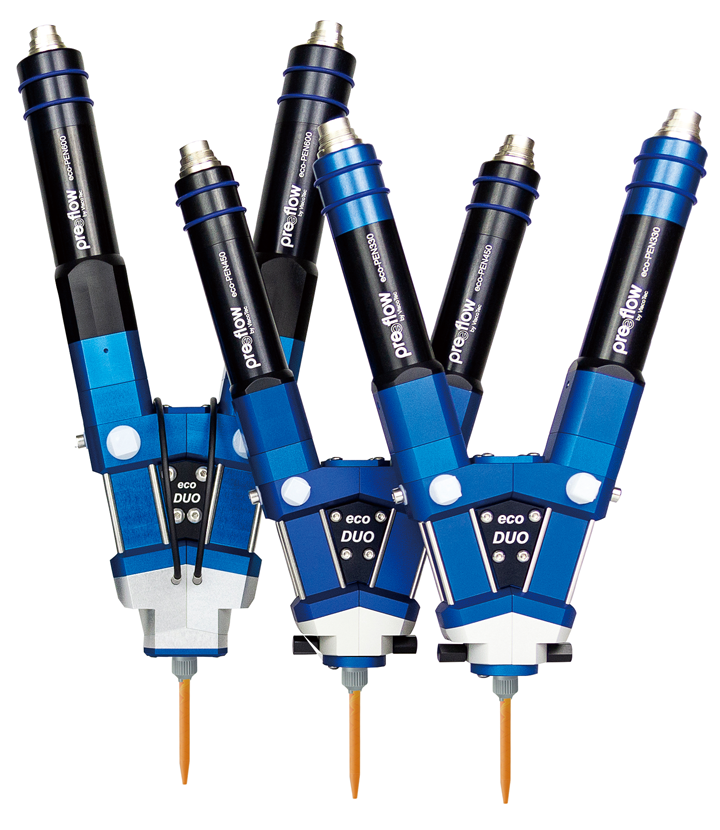
preeflow® eco-DUO330/450/600
A high-precision dispenser that can precisely mix and dispense fixed quantities of two-component materials.
Achieves stable mixture ratio when sealing electronic components inside the motor.
- Simultaneous transfer of base resin and hardener with quantitative accuracy of ±1%, maintaining accurate mixing ratio
- Stable discharge control unaffected by pressure, temperature, or time
- Pulsation-free continuous discharge forms a uniform sealing layer
- Also compatible with two-component materials with different viscosities
- Ideal for motors and automotive electronic components that require high reliability
 San-Ei Tech (Thailand) Co., Ltd. Liquid Dispenser เครื่องหยอดของเหลว