Table of Contents
Assignment background
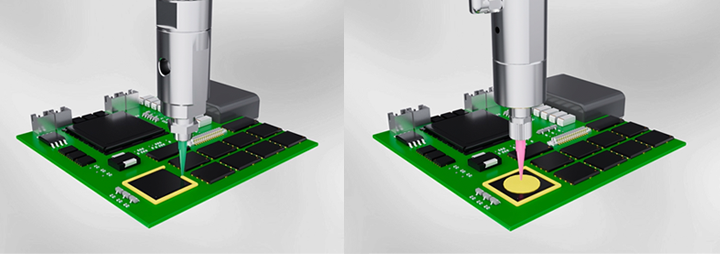
In the semiconductor package manufacturing process, the “Dam & Fill” method of dispensing liquid materials is widely used to encapsulate circuit boards and electronic components. With this method, a “dam” is first formed using high-viscosity epoxy, and then the “fill” is performed using low-viscosity epoxy. However, conventional dispensing equipment and valves have presented several technical challenges, including the following:
- Dripping and bleeding easily occur when applying high viscosity materials
The dam shape became unstable, causing unevenness, etc. As a result, the fill area became less uniform, affecting product quality. - If the dam material contains hard fillers, the valves will wear out quickly.
When handling hard particles or highly filled materials, the discharge mechanism is prone to wear, necessitating regular maintenance and part replacement, which impacts production efficiency. - It is difficult to adjust the amount and flow rate of the filling liquid.
When applying small amounts with precision, problems such as air bubbles, dripping, and overflow due to excessive dispensing are likely to occur, making it difficult to achieve reliable sealing. - Switching between dam and fill on the same line requires a lot of setup changeover work.
Switching between coating devices and adjusting conditions takes time and effort, making it inefficient for high-mix, low-volume production lines.
Benefits
To address these issues, we recommend our dedicated dispenser valves (SV35DA/SV51) that are optimized for dam and fill use. By combining the two, the stability and reproducibility of the process has been greatly improved, making it possible to achieve both quality and production efficiency at mass production sites.
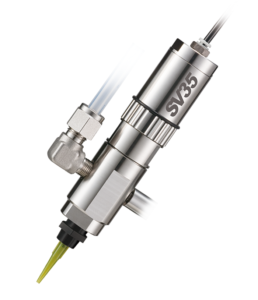
[Dam formation] SV35DA piston valve
- It can stably dispense medium to high viscosity epoxy materials, allowing for sharp, uniform line formation.
- The suck back mechanism prevents dripping and stringing, and reduces liquid accumulation at the end point.
- The structure uses a UHMW diaphragm, which reduces wear on the liquid-contacting parts and ensures a long service life.
- It can flexibly follow unevenness and complex shapes on the package substrate, ensuring reliable dam formation.
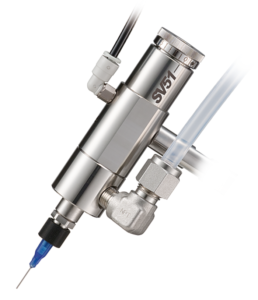
[Filling process] SV51 needle valve for micro-application
- It can precisely control minute amounts down to 0.001cc, and can accurately fill narrow spaces.
- Flow rate control is easy and it can flexibly accommodate different board sizes and shapes.
- The structure uses a UHMW diaphragm, which reduces wear on the liquid-contacting parts and ensures a long service life.
- Excellent liquid drainage prevents bleeding and stringiness, and minimizes the risk of air bubbles.
- Simple structure, no maintenance required, and a long-life design that can withstand repeated operation for millions of cycles.
Application video
Introduced products
Piston valve SV35DA
- Suck-back action ensures liquid is shut off
- UHMW diaphragm is used to handle abrasive materials
- Prevents dripping and bleeding, creating sharp dam lines

Needle valve for small amount dispensing SV51
- Accurately dispenses small amounts down to 0.001cc
- Simple structure prevents air bubbles from entering
- Excellent liquid drainage, beautiful application end point, and low maintenance specifications