
Assignment background
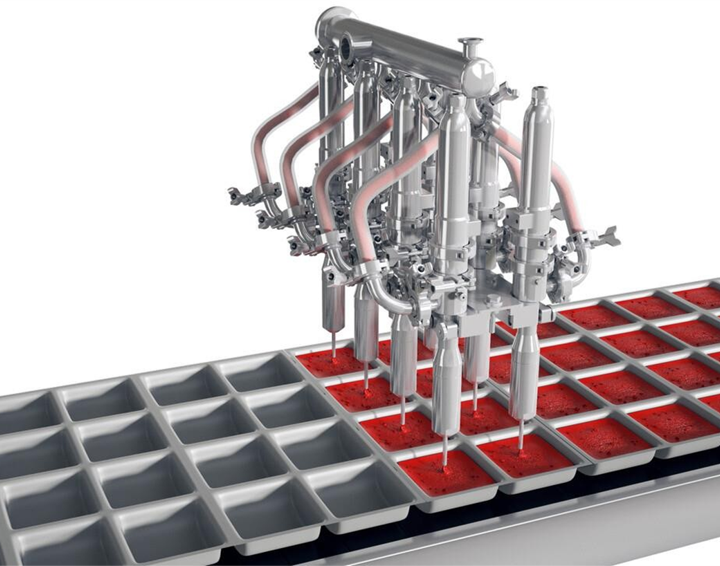
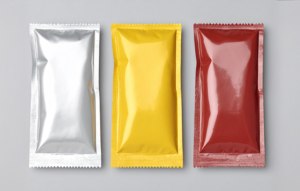
Filling highly viscous food ingredients such as jams, pastes, and creams into small-volume cups or stick pouches is an essential process on food production lines. Applications are extremely diverse, including breakfast jams at hotels, seasoning packs at restaurant chains, and dessert sauces at convenience stores, and small-volume packaging offers great convenience for consumers. However, because product quality and consistency of content are directly linked to consumer satisfaction and brand image, particularly strict management is required at manufacturing sites.
However, conventional filling methods have the following issues:
- Small capacity leads to larger errors
With small volumes of around 10-20ml, a difference of just a few milliliters can lead directly to product defects. For example, if there is a difference of ±2ml in a 15ml standard stick pouch, there is a risk that the consumer will perceive it as “too little” or that it is “overfilled and unnatural.” Furthermore, underfilling results in the product being discarded as out-of-spec, while overfilling leads to material loss, and both cases significantly reduce yield. - Material loss and increased costs
Jams and creams in particular have high production costs, so if overfilling by a few milliliters accumulates, it will result in a huge amount of material loss per year. With mass-produced small-volume products, even a seemingly small error can become a huge cost burden when converted into hundreds of thousands of packs, squeezing profit margins. - Decrease in production efficiency
Diversifying demand for small-lot, multi-product production is on the rise for small-lot filling. This means that frequent lot changeovers and volume changes are unavoidable on production lines. However, conventional equipment has a complex structure, and volume adjustments and cleaning work take time, which sometimes means the line has to be stopped for long periods of time when changing over. As a result, the operating rate drops, affecting the entire production plan.
Benefits
The newly introduced sanitary filling pump (food series) is flexible enough to handle dosages from 10 ml to 2,000 ml and has a wide flow rate range of 13 ml/min to 80 liters/min, significantly improving previous issues with small-volume filling.
- Achieves high-precision filling even with small volumes
Previously, when filling small volumes of around 10 to 20 ml, an error of a few milliliters was a major problem, but the sanitary filling pump is capable of stable dispensing with a high accuracy of ±1%. This means that for a 15 ml standard, the error is within ±0.15 ml, making it possible to provide products with the “just right amount” for consumers. - Reduced material waste and increased cost efficiency
Preventing overfilling reduces raw material waste. For expensive raw materials such as jam and cream, even an improvement of just a few milliliters can lead to significant cost savings over the course of a year. On one line, raw material usage was reduced by approximately 5-8% after implementation, directly leading to improved profit margins. - Flexible response to small lot and high-mix production
With a wide dosage range and easy setting changes, the same equipment can handle everything from small-volume stick pouches to medium-volume cup filling. Previously, separate equipment was required for each line, but after the introduction, a single machine was able to handle a wide range of product specifications, and line changeover time was significantly reduced. - Improved cleaning and hygiene
The design complies with international food hygiene standards such as EHEDG and FDA, reducing the risk of residue and microbial contamination.The simple structure makes it easy to disassemble and clean, making it suitable for frequent changeovers and hygiene management requirements.
Introduced products
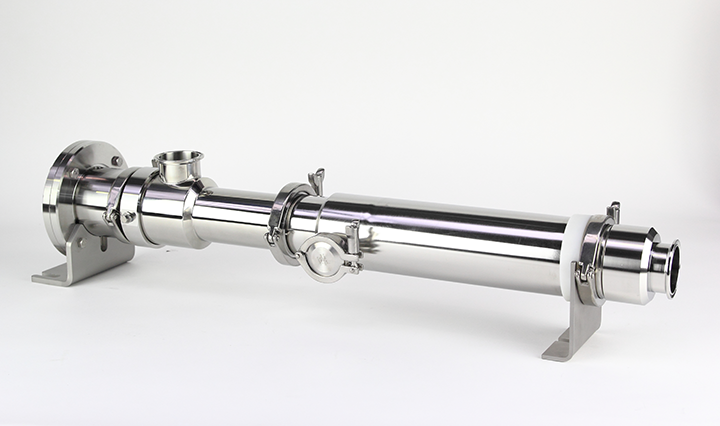
Sanitary filling pump (food series)
This is the optimal solution for accurately and efficiently filling small containers with highly viscous food ingredients such as jams and pastes.
- Dosage: Compatible with 10ml to 2,000ml (flexible support for small to large volumes)
- Volumetric flow rate: 13 ml/min to 80 liters/min
- Compliant with international food hygiene standards such as EHEDG and FDA
- Simple structure makes cleaning and maintenance easy
 San-Ei Tech (Thailand) Co., Ltd. Liquid Dispenser เครื่องหยอดของเหลว